


What is something that pretty much everyone, no matter what dietary practice they follow, can agree on (or at least I hope so)? Eating whole foods elicits better health outcomes than consuming ultra-processed foods. It might be helpful to clarify a few definitions here: what do I mean when I say whole foods? In the context of this post, whole foods are described as whole, unrefined foods as close to their natural state as possible. Pretty straightforward.
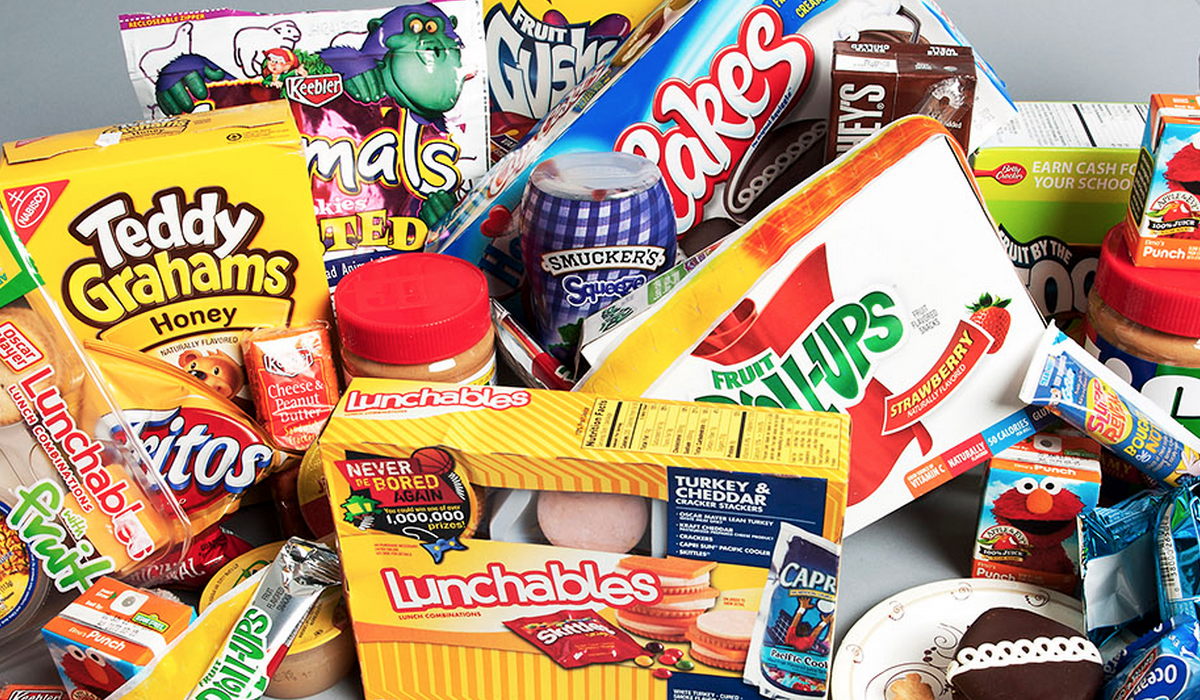
So, what are ultra-processed foods? Ultra-processed foods have been described previously in the scientific literature. Monteiro et al. (2018) described them as, “formulations mostly of cheap industrial sources of dietary energy and nutrients plus additives, using a series of processes” (1). In other words: foods that have been stripped of their healthful qualities (fibre, vitamins, minerals, etc.) and often mixed with additives/preservatives to make them last longer, and be more shelf-stable.
Example
An example of a whole food is the whole-grain wheat berry. This is a whole-grain, meaning it contains all parts of the grain: the endosperm, germ, and bran, and thus is fibre-rich and nutrient-dense (side-note: less than 5% of Americans consume the recommended daily intake of fibre, so eat more whole-grains! [2]). The processed version of this grain is white flour: most of the grain (germ and bran) has been stripped away, leaving the endosperm, and virtually no fibre/nutrients.
Industrialization of Agriculture
Body mass index (BMI) has been on the rise since the 1880s, coinciding with the industrialization of agricultural practices (see figure 1) (3).
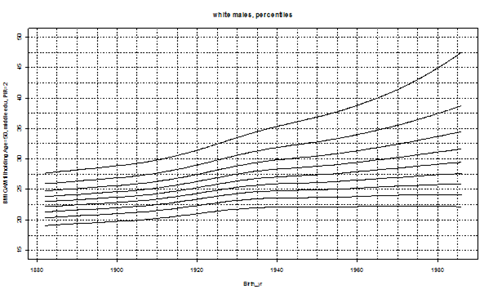
This industrialization led to the rise of the processed food, where refined grains and flours, sugars, fats/oils, and additives became widely used in food preparations. During the early twentieth century (1909-1913), 68% of total carbohydrates came from starch, in comparison to 47% in 1980. The starch consumption was largely swapped out for refined sugar, with the contribution of sugars increasing from 32% during 1909-1913 to 53% in 1980 (4).

This trend has continued. More recently, a study from 2015 using data from the 2009-10 National Health and Nutrition Examination Survey (NHANES) reported that Americans are consuming almost 60% of their diet from ultra-processed foods (5).
Replacing these ultra-processed foods with whole foods could have major benefits on people’s health, potentially reducing the financial burden we are placing on our healthcare systems. A massive 90% of America’s $3.3 trillion in annual health care expenditures are for those with chronic and mental conditions (6,7). This trend is echoed in my home country of Ireland, where it is estimated that three quarters of the healthcare expenditure is allocated to the management of chronic disease (8).
What’s Wrong with Ultra-Processed Foods?
Okay, by now you should have an idea as to how commonly consumed ultra-processed foods are. So, what’s the big deal?
There are some proposed mechanisms to explain why they may be negative to our health: refining healthful carbohydrate-rich foods like whole-grains takes away most of the fibre, vitamins, minerals, phytonutrients, and such, while spiking your blood sugar levels and providing very little satiety. Refining healthful sources of fats into processed oils results in a product that has no fibre, very little nutrients, and is a concentrated source of calories (most calorie-dense food in existence: roughly 4,000 calories per pound).
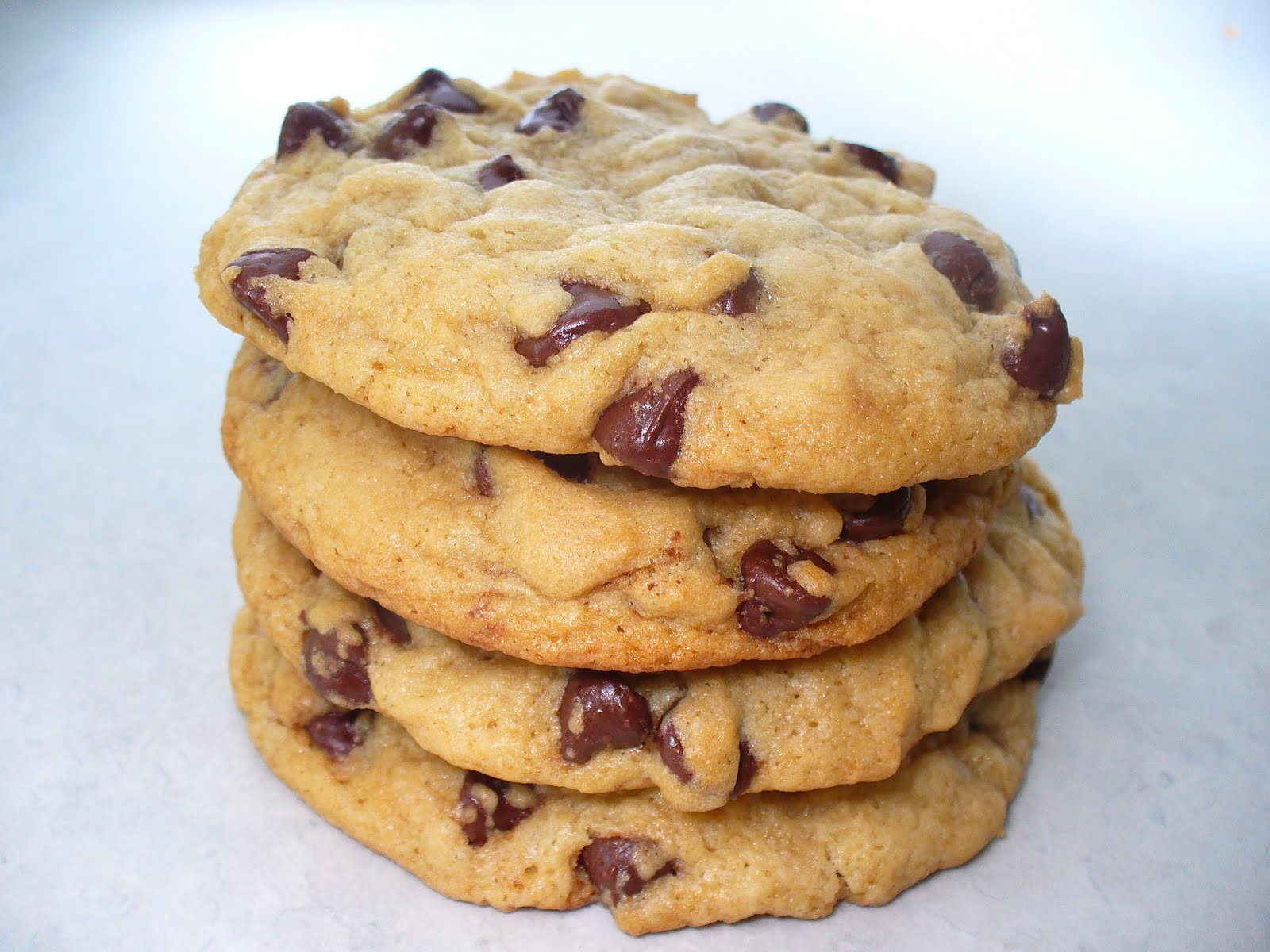
When you mix these refined foods together to make, for example, a cookie (mix of refined flours and sugars, and oils, etc.), you are looking at an ultra-processed food with little relevance for human health. A diet consisting of a large portion of these foods is going to cause long-term health problems in the majority of people due to the lack of nutrients, and the likely excess calorie intake.
The excess calorie intake will lead to overweight/obesity and this can lead to chronic diseases such as type 2 diabetes and cardiovascular disease (9). Likewise, a lack of nutrient intake, in the form of vitamin and mineral deficiencies, has been shown to be associated with increased risk of chronic diseases, and improving nutrient intakes may be important for reducing progress of chronic diseases (10).
New Data
A great new study (published last Tuesday, 2nd July) led by a researcher named Kevin Hall, who works at the National Institutes of Health, has looked at the effects of ultra-processed vs. unprocessed diets on energy (calorie) intake, and body weight (11).
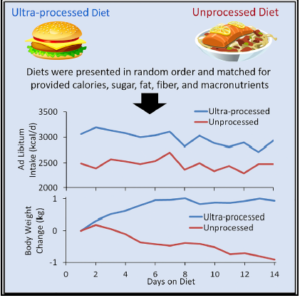
This study was conducted to try and address the reasons why ultra-processed foods may increase energy (calorie) intake and therefore cause weight gain. The beauty of Hall’s studies is that they are conducted in an in-patient metabolic ward facility—allowing the researchers 100% control of their diets. 10 men and 10 women were randomized to consume one diet for two weeks, and then they swapped over to eat the other diet for 2 weeks. The unprocessed and ultra-processed diet groups were both given 3 meals a day and were instructed to eat ad libitum (as much as they desired). Snacks were provided at all times throughout the day. Both diets were calorie-matched and were macronutrient (i.e. protein/carbohydrate/fibre/fat) matched to the best of the researchers’ abilities. The only difference therefore was: one diet was comprised of ultra-processed foods, the other was comprised of unrefined foods.
The Results
There was a significant increase in energy (calorie) intake in the ultra-processed diet group of an average extra 508 calories per day. In stark contrast, there was no significant difference in energy intake in the unprocessed diet group. This shows that processing foods reduces satiety and causes overeating. These results are helpful in forming a causal relationship between increased ultra-processed foods intake and increased obesity. Interestingly, this study showed that the appetite suppressing hormone peptide tyrosine tyrosine (PYY) increased in the unprocessed diet vs. the ultra-processed diet, and the hunger hormone ghrelin decreased in the unprocessed diet too, signifying greater satiety.
In conclusion, the authors suggest that eliminating ultra-processed foods from the diet decreases energy intake and results in weight loss, and that a diet with a large proportion of ultra-processed food increases energy intake and therefore leads to weight gain.
Real Life Application
Now that you’re armed with this knowledge, what are you going to do? You may want to lose weight, you may be suffering from a chronic illness, or you may just not feel your most energetic and healthy self. Whatever the case may be, eliminating or seriously reducing these ultra-processed foods is the quickest, and easiest way for you to improve your health.
To help you get started, here are some examples of swapping out ultra-processed foods with some unprocessed/minimally processed alternatives:
| Ultra-Processed Foods | Unrefined Foods |
| Lucky Charms cereal | Oatmeal with berries |
| Orange juice | Whole orange |
| Refined bread (white/brown) – check labels, if it doesn’t say ‘WHOLE’ before the flour in the ingredients, it isn’t wholegrain | Whole-wheat bread, whole-grain rye bread |
| Coke | Flavoured, sparkling water |
| French fries | Baked potato |
| Snickers bar | Fruit/nut bar |
| White rice (fried) | Brown rice (boiled) |
| Chocolate-chip cookies | Homemade oat/banana cookies |
Final Note
It is clear that on a population level, we need to cut down on ultra-processed food consumption, in favour of more unrefined alternatives. Unfortunately, in some scenarios (food poverty, for example) this is easier said than done. But if you are reading this, and you have the means to make a few changes in this direction, I encourage you to do so.
Peace.
References
(1) Monteiro, C.A., Cannon, G., Moubarac, J.C., Levy, R.B., Louzada, M.L.C., and Jaime, P.C. (2018). The UN Decade of Nutrition, the NOVA food classification and the trouble with ultra-processing. Public Health Nutr. 21, 5–17. URL: https://www.cambridge.org/core/services/aop-cambridge-core/content/view/2A9776922A28F8F757BDA32C3266AC2A/S1368980017000234a.pdf/un_decade_of_nutrition_the_nova_food_classification_and_the_trouble_with_ultraprocessing.pdf
(2) Marriott BP, Olsho L, Hadden L, et al. Intake of added sugars and selected nutrients in the United States, National Health and Nutrition Examination Survey (NHANES) 2003–2006. Crit Rev Food Sci Nutr. 2010;50:228–258. URL: https://www.ncbi.nlm.nih.gov/pubmed/20301013
(3) Komlos, J. and Brabec, M. (2010). THE TREND OF BMI VALUES OF US ADULTS BY CENTILES, BIRTH COHORTS 1882-1986. National Bureau of Economic Research. URL: https://www.nber.org/papers/w16252.pdf
(4) Welsh, S.O., and R.M. Marston. 1982. Review of trends in food use in the United States, 1909 to 1980. J Am Diet Assoc. 81:120-125. URL: https://www.ncbi.nlm.nih.gov/pubmed/7050214
(5) Martinez Steele et al. (2015). Ultra-processed foods and added sugars in the US diet: evidence from a nationally representative cross-sectional study. Public Health Nutr. 21, 114-124. URL: https://bmjopen.bmj.com/content/6/3/e009892
(6) Buttorff C, Ruder T, Bauman M. Multiple Chronic Conditions in the United States Santa Monica, CA: Rand Corp.; 2017. URL:
https://www.rand.org/content/dam/rand/pubs/tools/TL200/TL221/RAND_TL221.pdf
(7) Center for Medicare & Medicaid Services. National Health Expenditure Data for 2016—Highlights URL: https://www.cms.gov/Research-Statistics-Data-and-Systems/Statistics-Trends-and-Reports/NationalHealthExpendData/Downloads/highlights.pdf
(8) Department of Health and Children. Tackling Chronic Disease: A Policy Framework for the Management of Chronic Diseases. URL: https://health.gov.ie/wp-content/uploads/2014/03/tackling_chronic_disease.pdf
(9) McArdle et al. (2013). Mechanisms of obesity-induced inflammation and insulin resistance: insights into the emerging role of nutritional strategies. Frontiers in Endocrinology, 4(52). URL: https://www.ncbi.nlm.nih.gov/pmc/articles/PMC3650620/pdf/fendo-04-00052.pdf
(10) Bruins, Van Dael, and Eggersdorfer (2019). The Role of Nutrients in Reducing the Risk for Noncommunicable Diseases during Aging. Nutrients, 11(1). URL: https://www.ncbi.nlm.nih.gov/pmc/articles/PMC6356205/pdf/nutrients-11-00085.pdf
(11) Hall et al. (2019). Ultra-Processed Diets Cause Excess Calorie Intake and Weight Gain: An Inpatient Randomized Controlled Trial of Ad Libitum Food Intake. Cell Metabolism, 30(1), pp. 67-77. URL: https://www.cell.com/action/showPdf?pii=S1550-4131%2819%2930248-7
 Candid Conscience
Serious read, keep it coming bud 👏👏
LikeLike
Thank you sir!
LikeLike
Love this, Patrick! I’ll probably link up to it in a future Veggie Quest post on carbs, assuming I ever get back to that. 😉 Very well put, though—I wish everyone would read this!
LikeLike
Thanks for reading Lee! And thank you for the kind words😊
LikeLike