


What makes for a happy, meaningful, and long-lived life? You may think that having family, friends, healthy eating habits, an exercise routine, a fulfilling career, or a combination of all of these things would contribute. That is the question that Dan Buettner set out to answer, when he teamed up with National Geographic to locate and study the world’s longest-lived people. Armed with a team of medical researchers, anthropologists, demographers, and epidemiologists, 5 places that satisfied the criteria of highest life expectancy were then studied (1).

The Blue Zones
- Barbagia region of Sardinia – Mountainous highlands of inner Sardinia with the world’s highest concentration of male centenarians.
- Ikaria, Greece – Aegean island with one of the world’s lowest rates of middle age mortality and the lowest rates of dementia.
- Nicoya Peninsula, Costa Rica – World’s lowest rates of middle age mortality, second highest concentration of male centenarians.
- Seventh Day Adventists – Highest concentration is around Loma Linda, California. They live 10 years longer than their North American counterparts.
- Okinawa, Japan – Females over 70 are the longest-lived population in the world.
These 5 places listed above were dubbed the Blue Zones. The researchers found 9 commonalities that existed within each and every one of these Blue Zones—deemed the Power 9:
- Move Naturally
- Purpose
- Down Shift
- 80% Rule
- Plant Slant
- Wine @ 5
- Belong
- Loved Ones First
- Right Tribe
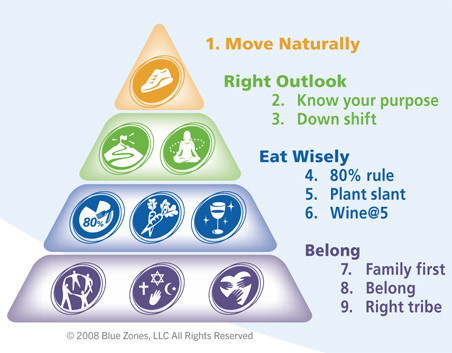
If you incorporate the principles of the Power 9 into your life, you’ll be well-equipped to hopefully live into old age. But that shouldn’t be the focus, the focus should be on being happy right now. These principles help to guide one towards a productive and fulfilling life, and thus more happiness in everyday life. So, what do they each entail?
1. Move Naturally
Too often we are stuck at our desks, or sitting on our couches watching television. We might feel like a quick run, or a 30-60-minute gym workout will offset this. Even multiple hours of intensive exercise should offset this, right? Well, the “active couch potato” phenomenon casts doubt over this assumption. In essence, there is research to show that even if you are meeting daily physical activity guidelines, if you’re sedentary for the remainder of the day, you may still be at a higher risk for chronic disease vs. those who are engaged in less sedentary behaviour (2). The individuals in the Blue Zones don’t necessarily work up a sweat in the gym, or run marathons, but instead they integrate daily movement as part of their lifestyle.

2. Purpose
These people know their sense of purpose: Okinawans call it “Ikigai”, Nicoyans call it “plan de vida”. This translates to “why I wake up in the morning” for both. This is such an important part of a happy existence, something which took me a long time to figure out, but since finding, has led to a lot more happiness. According to Buettner, knowing your purpose is worth up to seven years of extra life expectancy.
3. Down Shift
This principle relates to how these people deal with stress. Unfortunately, a stress-free life is unavoidable, but we can deal with it better. The Okinawans take a few moments each day to remember their ancestors, the Adventists in California pray, Ikarians routinely nap, and Sardinians do happy hour. These are a select few ways to be more mindful in our daily lives that have larger benefits for our wellbeing.

4. 80% Rule
This rule refers to being more mindful of how much we eat. In Okinawa, it is called “hara hachi bu”. This mantra is said before meals to remind them to stop eating when their stomachs are 80% full. This 20% gap may be the difference between losing weight or gaining weight. The common theme within all Blue Zones is that they eat earlier in the day, with their final and smallest meal coming in the late afternoon/early evening.
5. Plant Slant
Each population in the Blue Zones eat a predominantly plant-based diet. Meat (mostly pork) is eaten only about 5 times per month, and the portions are small (3-4 ounce servings; size of a deck of cards). Legumes such as beans and lentils are staples of their diets. The specific varieties vary from place to place, but include: fava beans, black beans, soy beans, and lentils.
6. Wine @ 5
Except for Adventists, people in all Blue Zones drink alcohol moderately and regularly. The quantities are roughly 1-2 glasses of wine per day, with friends and/or food. This does not mean you should start drinking if you don’t! It just shows that indulging in one or two glasses in social situations (while having an already healthy lifestyle), is not an issue.

7. Belong
All but 5 of the 263 centenarians interviewed belonged to some faith-based community. The denomination did not matter, it was the practicing that mattered. According to Buettner, research shows that attending faith-based services 4 times per month can add anywhere between 4-14 years of life expectancy.
8. Loved ones First
Centenarians in the Blue Zones look after their families, closely. They keep aging relatives nearby or in the home, they commit to a life partner, and invest love and time into their children.
9. Right Tribe
The world’s longest-lived people choose social circles that support healthy behaviors. In Okinawa, they chose “moais”—groups of 5 friends that commit to each other for life. Research from the Framingham Studies shows that smoking, obesity, happiness, and even loneliness are contagious, highlighted by the statistic that a person’s chances of becoming obese increased by 57% if he or she had a friend who became obese in a given interval (3). In other words, habits are contagious, so choose your friends wisely.
Putting This into Practice
The beauty of this study is that it helps to show that implementing these common practices elicits longevity benefits in genetically diverse populations. This infers that if we all take these practices into consideration for our own lives, we too can reap the benefits.
Quick Note on “Active Couch Potato” Phenomenon

This is a fairly new school of thought, but in basic terms, the perspective is that too much sitting is distinct from too little exercise (2). Work from Hamilton et al. has provided evidence that prolonged sedentary activity has negative health ramifications. Specifically, the suppression of an enzyme called skeletal muscle lipoprotein lipase (LPL) and reduced glucose uptake (4,5). The suppression of LPL has the negative effect of reducing triglyceride uptake and HDL-cholesterol—the so-called “good” cholesterol—production, and reduced glucose uptake is associated with metabolic syndrome and type-2 diabetes. Good news though, even standing as opposed to sitting can mitigate these negative physiological processes (bring on standing desks!).

In Summary
Taking the Blue Zones as a case study, it is evident that we have greater control over our health and longevity than we probably thought possible. I hope you take something from this blog post on board and take a step (no matter how big or small) towards a happier, healthier, and more fulfilled life.
Challenge for the Week
Here’s a fun challenge for you to get the ball rolling: Take a step each day this week to be more like the people in the Blue Zones. Today you may make it your mission to walk 10,000 steps (most don’t get near this number!). If that’s too ambitious, commit to 5,000. Perfection is not the goal, but we must take steps in the right direction. Tomorrow maybe incorporate a “down-shift”. This could be 5-10 minutes of meditation, or a yoga class (Insight Timer is a great app with thousands of free guided meditations). Every time you do these things, it becomes easier to keep building from there. It’s about gaining momentum and forming healthy habits. Maybe by the end of the week you will eat a plant-based meal, or better yet, a day of plant-based eating. Writing these goals down is powerful, and can enhance adherence to these behaviours.

Once again, my hope is that you are more knowledgeable on how to better yourself. I hope you all have a wonderful week.
References
(1) Dan Buettner. Blue Zones. Power 9: Reverse Engineering Longevity. URL: https://www.bluezones.com/2016/11/power-9/
(2) Owen et al. (2010). Too Much Sitting: The Population-Health Science of Sedentary Behavior. URL: https://www.ncbi.nlm.nih.gov/pmc/articles/PMC3404815/
(3) Christakis and Fowler, (2007). The spread of obesity in a large social network over 32 years. URL: https://www.ncbi.nlm.nih.gov/pubmed/17652652
(4) Bey and Hamilton, (2003). Suppression of skeletal muscle lipoprotein lipase activity during physical inactivity: a molecular reason to maintain daily low-intensity activity. URL: https://www.ncbi.nlm.nih.gov/pmc/articles/PMC2343229/
(5) Hamilton et al. (2004). Exercise Physiology versus Inactivity Physiology: An Essential Concept for Understanding Lipoprotein Lipase Regulation. URL: https://www.ncbi.nlm.nih.gov/pmc/articles/PMC4312662/
 Candid Conscience
Another great read and ‘food’ for thought. Keep it up Patrick!:)
LikeLike
Legend Cormac, thank you!
LikeLike
Super interesting topic Pat, especially the Active couch potato study (giving the poor spud a bad rep though haha) ! Keep up the good work 🙂
LikeLike
Haha I love the spuds! Thank you!
LikeLike
– Eden
LikeLike